


Listen or Download Article Audio
As a teacher, I’ve seen how much learning happens before we ever open a textbook.
A child walks into the classroom frustrated because something didn’t go their way that morning. Another is nervous about working with a new partner. Someone else is having a hard time waiting for their turn.
Before we can focus on reading, math, or writing, we sometimes need to help children figure out what to do with all those feelings.
And if you’ve spent any time in an elementary classroom, you know those moments are part of every school day.
We often think about social-emotional learning (SEL) as helping children manage emotions, build friendships, and make thoughtful choices. But new research is raising an interesting question:
Could the development of social-emotional skills also be connected to school attendance?
In October 2026, the Collaborative for Academic, Social, and Emotional Learning (CASEL) released a special research quarterly focused on attendance.
Among the studies highlighted was new research suggesting a relationship between students’ social-emotional growth and chronic absenteeism.
The findings deserve attention, especially as schools continue looking for meaningful ways to support students and families.
Is Social-Emotional Learning Connected to School Attendance?
Research suggests that social-emotional development and school attendance may be related.
A 2026 study highlighted by CASEL examined 1,863 middle school students and found that those who demonstrated greater growth in social-emotional competencies were less likely to be chronically absent than comparable students who showed no growth.
Overall, greater social-emotional growth was associated with more than 47% lower odds of chronic absenteeism.
That is an interesting finding, but it’s important to understand what it means.
The study was correlational. It did not establish that teaching SEL skills directly caused students to attend school more often. And because the study involved middle school students, we shouldn’t assume the same results apply to kindergarten through third grade.
Still, it raises an important question about how children’s social-emotional development fits into their overall school experience.
What Does Social-Emotional Growth Look Like in Everyday Life?
When we hear the word “growth” in education, we often think about test scores, reading levels, or mastering a new math skill.
But social-emotional growth can look a little different.
It might be the child who once became overwhelmed when a game didn’t go their way but is beginning to recognize when they need a break.
Or the student who used to walk away from a disagreement and is learning to explain what happened.
Maybe it’s the child who raises their hand to ask for help instead of sitting quietly and feeling frustrated.
These changes may seem small, but they represent skills children can use throughout their lives.
Social-emotional development includes learning to recognize feelings, manage reactions, understand other people’s perspectives, build relationships, and make responsible decisions.
And just like learning to read, these skills take time and practice.
We wouldn’t expect a child to read a chapter book after one phonics lesson. So why would we expect them to manage disappointment perfectly after practicing a breathing exercise once?
Why Might Social-Emotional Skills Matter for School Engagement?
Think about how many social and emotional challenges children navigate during a typical school day.
They separate from their caregivers in the morning.
They work with classmates who have different ideas.
They wait their turn.
They make mistakes.
They handle changes in routines.
They experience excitement, disappointment, frustration, and sometimes worry.
That’s a lot for a young child.
When children develop ways to recognize their feelings, ask for support, and work through challenges, those skills may help them participate more comfortably in classroom life.
Of course, that doesn’t mean a child who struggles with attendance simply needs better emotional regulation skills.
There are many reasons children miss school, including illness, transportation challenges, family circumstances, and barriers outside their control.
The research doesn’t suggest that SEL replaces the need to address those challenges.
Instead, it encourages us to consider social-emotional development as one part of a much bigger picture.
Four Simple Ways to Practice Social-Emotional Skills During the School Day
Here’s the part I love most: we don’t need to wait for a special lesson to help children practice these skills.
Everyday classroom moments give us opportunities.
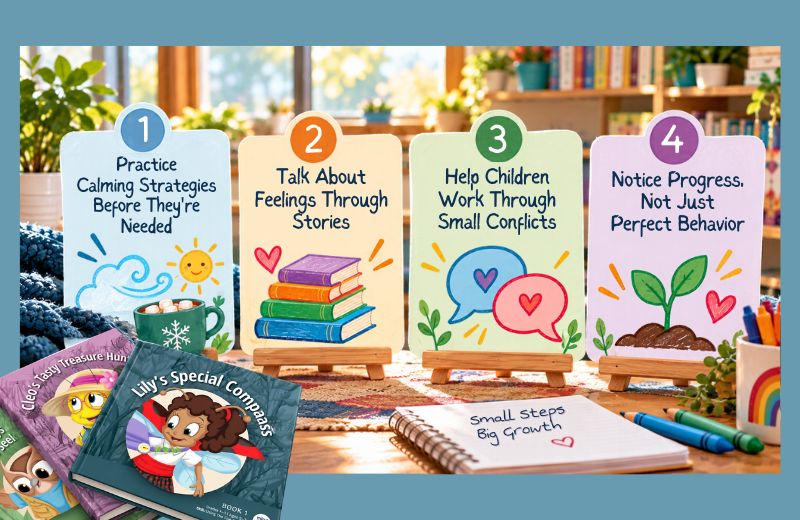
1. Practice Calming Strategies Before They’re Needed
I often think about how we teach children safety procedures.
We don’t wait until there’s an emergency to explain what to do.
The same idea applies to emotional regulation.
If we want children to use a calming strategy when they’re frustrated, it helps to practice when they’re already feeling comfortable.
Take a minute to breathe before a transition.
Invite children to notice how their bodies feel after a movement break.
Practice slowly breathing in and out together before beginning a challenging activity.
The goal isn’t to eliminate big feelings. It’s to help children become familiar with tools they can choose when those feelings arrive.
2. Talk About Feelings Through Stories
Books are one of my favorite ways to explore social-emotional skills with children.
When a character feels embarrassed, disappointed, excited, or left out, we can pause and ask what might be happening.
“What do you think they’re feeling?”
“What clues helped you figure that out?”
“What could they do next?”
“Have you ever felt something similar?”
These conversations allow children to explore emotions without having to share personal experiences before they’re ready.
Stories also give us opportunities to discuss friendship, kindness, cooperation, and the consequences of different choices.
3. Help Children Work Through Small Conflicts
Put a group of young children together with a limited number of crayons, popular toys, or coveted classroom jobs, and disagreements are going to happen.
That’s not necessarily a bad thing.
Those everyday conflicts give children opportunities to practice listening, explaining their needs, considering another person’s perspective, and finding solutions.
Instead of immediately deciding who gets the blue crayon, we might ask:
“What happened?”
“What does each person need?”
“What could you do so both of you can keep working?”
Sometimes children will need an adult to help them through the entire conversation.
That’s okay. They’re learning.
4. Notice Progress, Not Just Perfect Behavior
One of the most encouraging parts of teaching is watching a child make progress in something that used to be difficult.
Maybe they still get frustrated, but now they recognize it sooner.
Maybe they still need help solving a disagreement, but they’re beginning to use words instead of walking away.
Maybe they remember to ask for a break after an adult gives them a reminder.
That’s growth.
And when we notice those small changes, we help children recognize that they’re learning skills they didn’t have before.
Instead of saying, “Good job being calm,” we might say:
“I noticed you asked for help when that became frustrating.”
Or:
“You had a different idea than your partner, and you listened to what they had to say.”
Specific feedback helps children understand what they’re learning and why it matters.
How Can Educators Recognize Social-Emotional Growth?
Not every important skill shows up on a traditional academic assessment.
We can look for patterns in children’s everyday experiences.
Are they beginning to name their emotions more clearly?
Do they recognize when they need help?
Are they becoming more comfortable joining group activities?
Can they listen to another person’s perspective?
Are they beginning to use familiar strategies when challenges arise?
Children develop at different rates, and progress won’t always be consistent.
A child who handles frustration beautifully on Tuesday might have a very difficult Thursday.
That doesn’t mean they’ve lost everything they’ve learned.
It means they’re human. And they’re still growing.
Educators can use observations, student reflections, and family conversations to understand how children are developing over time.
These observations can complement, rather than replace, other measures schools use to understand student experiences.
Where Does SEL Fit Into the Bigger Attendance Conversation?
The CASEL research quarterly highlights more than the connection between social-emotional growth and attendance.
It also examines the role of school climate, safety, relationships, and students’ sense of connectedness.
Together, these findings encourage schools to think beyond attendance numbers alone.
Children need safe, welcoming environments. Families need practical support when barriers arise. Schools need strong relationships and consistent communication.
And children benefit from opportunities to develop the skills that help them navigate the school day.
SEL isn’t a solution to every attendance challenge, and it shouldn’t be presented that way.
But helping children recognize emotions, build relationships, and manage everyday challenges is valuable work in its own right.
At Mind Body Align, that’s part of why we created the Labyrinth Adventures storybook series. Through stories, conversations, and simple activities, children can practice emotional awareness, focused attention, self-regulation, and connection in ways that fit naturally into the school day.
Those experiences are intended to support children’s development. They aren’t a substitute for comprehensive attendance interventions, and we don’t claim that the curriculum has been proven to reduce absenteeism.
The Small Steps Matter
As teachers, we know that learning rarely happens all at once.
A child practices.
They make mistakes.
They get frustrated.
They receive support.
And eventually, something that once felt impossible starts to feel manageable.
Social-emotional skills develop the same way.
The new research highlighted by CASEL gives schools another reason to pay attention to that growth and consider how it connects with students’ broader school experiences.
But for those of us spending our days with young children, the work often comes back to the moments right in front of us.
A child taking a breath before responding.
Two classmates finding a way to share.
A student asking for help.
A teacher noticing that something is getting a little easier.
Those moments may not make headlines.
But they’re worth noticing.
And they’re worth making time for.

Julie Braumberger is Director of Education at Mind Body Align, a former third-grade teacher, and co-creator of Labyrinth Adventures. She draws on her classroom experience to develop practical whole child development resources that help children build self-regulation, emotional awareness, connection, and other skills they can use in school and beyond.
Research referenced: CASEL, Data-Driven: A Research Quarterly for Education Leaders, October 13, 2026, Attendance Special Issue. The quarterly summarizes Johnson, Taylor, and Robitaille’s 2026 correlational study, Social-emotional growth as a protective factor against chronic absenteeism, published in Social and Emotional Learning: Research, Practice, and Policy.