


Listen or Download Article Audio
I grew up in a large, loud family. I love them dearly. We are also…a lot. We are well aware.
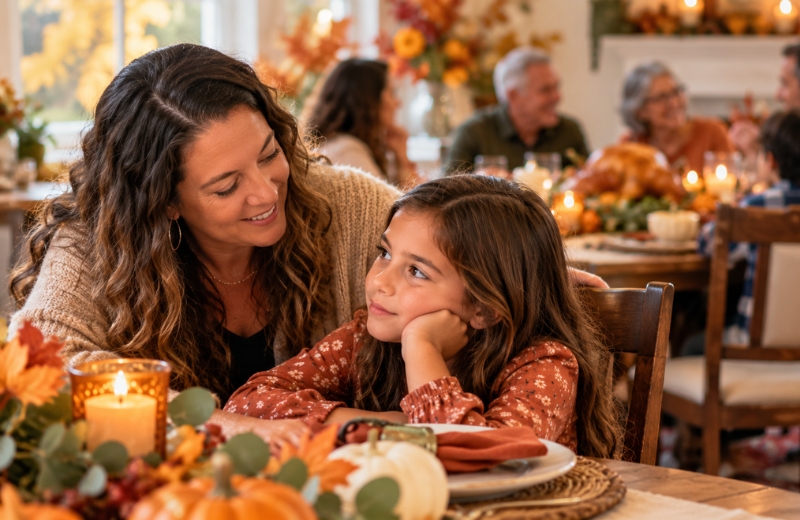
Family gatherings are busy and intense on an ordinary day. Pile on the excitement, expectations, extra people, everyone’s cooking, and the general chaos of a holiday, and it can be overwhelming, especially for a child who is anxious, cautious, or simply needs a little more time to warm up. Add tights, dress shoes, or an itchy holiday outfit, and you’ve put a bow on top of the whole thing.
Fortunately, some of our big family holidays were hosted at my house when I was growing up. I could disappear into my bedroom for a few minutes, regroup, and come back when I was ready.
Now I encourage my own children to take breaks at family gatherings when they need them. And they’re also encouraged to take me with them!
For us, the most important part of preparing for a holiday gathering is that we talk about it beforehand.
How Can You Help Kids Prepare for a Big Family Gathering?
Prepare children by talking about what to expect, making a plan for breaks, practicing uncomfortable social situations ahead of time, and discussing what they can do if something feels overwhelming. Knowing they can ask for help or step away briefly can make a busy gathering feel more manageable.
Talk About What to Expect
Before a big day, we go over the basics. Who’s going to be there? When are we eating? Are we taking family pictures? What are we wearing? And exactly how long are we expected to remain in those clothes?
These details may seem minor to an adult, but they can matter quite a bit to a kid. When I was growing up, the rule at family gatherings was that you couldn’t take your shoes off until Aunt Peggy did. I don’t know when or how Aunt Peggy earned this authority, but we all understood it.
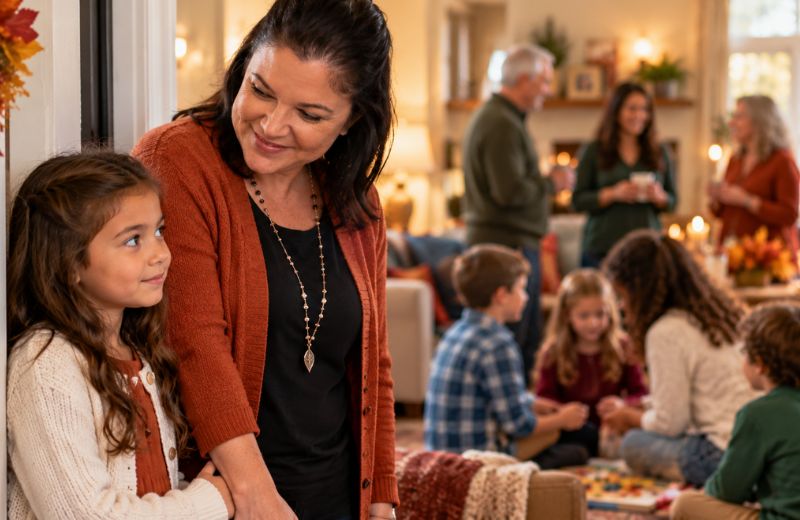
For some kids, knowing who will be there matters, too. Relatives they don’t see very often may be understandably excited to see them, which can mean lots of questions and attention the minute everyone walks through the door. Knowing that’s likely to happen gives children a chance to think about how they’d like to respond before they’re standing in the middle of it.
Make a Break Plan
At my parents’ house, my kids know they can take a self-imposed time-out when they need one. Our rules are pretty simple. First, tell the nearest parent where you’re going. That could be me, their dad, my sister, or their uncle. (We co-parent well in public.)
Second, take the time you need to regroup. In our family, we also talk beforehand about the parts of the gathering we expect everyone to participate in, like the meal or a family tradition. That way, taking a break isn’t treated as doing something wrong. It’s simply part of the plan.
If there isn’t a quiet room available, make a Plan B. Take a trusted adult outside for a short walk. Find a less busy corner. Use earplugs if noise is the problem. Even five quiet minutes in the bathroom can give an overwhelmed child a chance to regroup.
A break doesn’t mean sitting silently and instantly feeling better. A child might play a short game, move, breathe, or simply have a few quiet minutes. In Tia Lets Go, from our Labyrinth Adventures series, Tia practices letting go of big feelings through movement by pretending to soar like an eagle. A holiday break might include stretching your arms like Tia, taking a few slow breaths, shaking out some energy, or simply noticing, What does my body need right now?
A few minutes of movement, breathing, or quiet can make it easier to head back downstairs and rejoin the crowd when they’re ready.
Practice the Awkward Social Moments Ahead of Time
Sometimes the hardest part is simply walking in. If other children are already playing, how can your child join them?
Practice a few possibilities:
“What are you guys playing?”
“Can I be on your team?”
It might feel silly to rehearse this at home, but having the words ready can make that first step a little easier.
The same goes for enthusiastic relatives. If your child doesn’t want a hug, give them kind words they can use: “No thank you, but I’m happy to see you!”
Or offer an alternative: a wave, high five, fist bump, or handshake. And teach the reverse just as intentionally: we ask before hugging other people, too. Respecting boundaries goes both ways.
But What If?
Ask your child if there is anything they are worried about.
Then listen to the what ifs.
What if it’s too loud?
What if I don’t like the food?
What if everyone asks me questions?
What if I don’t know the other kids?
Avoid the easy response, You’ll be fine, because reassurance doesn’t necessarily answer the thing they’re worried about. Instead, make a plan together.
Maybe they eat a healthy snack before you leave so unfamiliar food isn’t quite so high-stakes. Maybe they need to be reassured they can eat what works for them without being pressured to clean their plate. Maybe you decide on a signal they can use when they need your help escaping a conversation.
Having a plan doesn’t guarantee that everything will be comfortable. It tells children, “If something feels hard, we can figure out what to do next.” That’s one way children begin learning, “I can handle something even when it feels hard.”
What Does Confidence Look Like at a Family Gathering?
The child who bursts through the door and immediately joins the cousins isn’t necessarily more confident than the child who hangs back for ten minutes.
For one child, courage might be joining the game. For another, it might be answering Great-Aunt Whoever’s third question.
It might be saying no to a hug, taking a break before becoming overwhelmed, trying one unfamiliar food, or coming back downstairs after some quiet time.
We can encourage children to stretch their comfort a little without asking them to ignore what their bodies are telling them.
Making Room for a Little Courage
Growing up, I didn’t always appreciate our big, loud family gatherings. Sometimes it was just a little too much. These days, I love getting everyone together, but I still appreciate a break from all that togetherness.
I want my kids to know they can enjoy the fun and still take a little time for themselves. And if that means we all disappear for a few minutes before heading back into the chaos, I consider that a holiday well spent.
That’s plenty of courage to bring to the table.

Brooke Unger is an educator and writer with Mind Body Align with experience as an elementary school teacher’s aide. She works directly with children and shares practical strategies that help educators and families support self-regulation, emotional awareness, and readiness to learn.