


Download or Listen to Article Audio
Why Children Need to Learn Emotional Skills Before They Need Them
We don’t wait for a fire to teach children what to do during a fire drill. We practice when the building is calm, show them where to go, and repeat it throughout the school year. We know the middle of an emergency is not the ideal time to learn a brand-new skill.
The same principle applies to emotional skills.
When a child is overwhelmed by frustration, angry with a friend, embarrassed by a mistake, or on the verge of tears, that is not the easiest moment to introduce taking a breath, noticing what is happening in their body, considering another perspective, or choosing what to do next.
Those skills need to be familiar before the difficult moment arrives.
Emotional regulation, problem-solving, and resilience aren’t emergency interventions reserved for children who are struggling. They are life skills, and like reading, riding a bike, or knowing what to do during a fire drill, they become more useful with practice.
Emotional regulation is a skill, not an expectation
Adults often use phrases like “calm down,” “make a good choice,” or “use your words.” But think about everything we’re actually asking a child to do in those few words.
To “calm down,” a child has to notice that their emotional state has changed, recognize signals from their body, slow an impulse, remember a strategy, and then use it. To “make a good choice,” they have to pause, consider options, and choose a response instead of simply reacting.
These abilities overlap with what scientists call executive function and self-regulation skills. The Center on the Developing Child at Harvard University describes these as mental processes that help us focus attention, remember information, control impulses, and adjust when circumstances change. Children aren’t simply born knowing how to do all of this. These capacities develop over time through experiences, supportive relationships, and practice.
So instead of only asking, “What should I do when this child becomes dysregulated?” we can also ask: “What can we practice together when we are calm?”
Why Emotional Regulation Is Easier to Use When Children Practice First
Emotional skills are a lot like first aid: training happens beforehand so the steps are familiar when they’re needed.
A child can practice taking a slow breath when they’re already calm. They can notice what tight shoulders, a fast heartbeat, or a relaxed belly feel like. They can talk about what a storybook character might do after an argument before they’re the one facing a disagreement. They can brainstorm solutions when the problem belongs to an imaginary character instead of themselves.
Every one of those moments gives a child an opportunity to rehearse.
Research on executive function and self-regulation supports this emphasis on practice. Harvard’s Center on the Developing Child notes that children can develop these skills through interactions and practice and recommends age-appropriate games and activities that help strengthen them over time.
The goal isn’t to make sure children never become angry, frustrated, disappointed, worried, or overwhelmed. Those feelings are part of being human. The goal is to give children more tools for what they can do when those feelings arrive.
Stress can make it harder to pause, focus, remember instructions, consider options, and resist an immediate impulse. Adults experience this too. Think about the last time you were running late, couldn’t find your keys, and had someone asking you three questions at once. You probably weren’t operating at your most patient, flexible, thoughtful best.
Children face that same challenge while their self-regulation skills are still developing. A breathing exercise they’ve tried once is an idea. A breathing exercise they’ve practiced again and again can become a tool.
Why Storytime Is an Ideal Place to Practice Emotional Skills
Fortunately, building emotional skills doesn’t always require adding another complicated program, lecture, or block of instruction. One of the best opportunities may already be part of a child’s day: storytime.
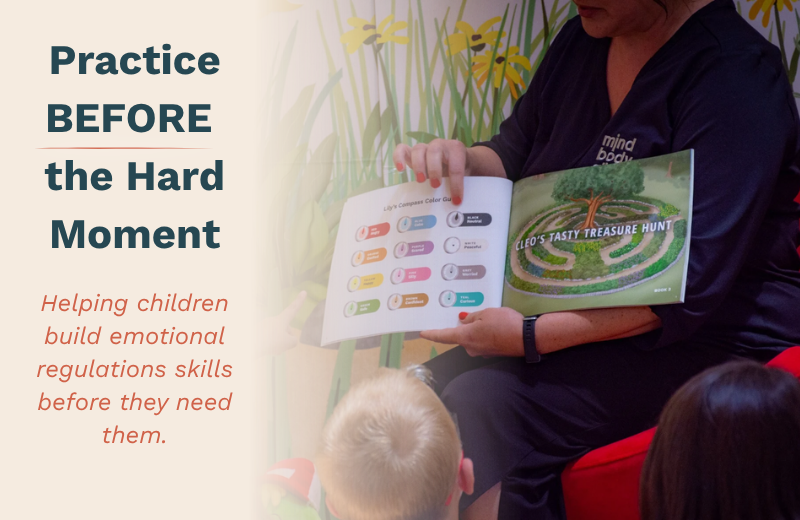
Stories give children a little emotional distance. A character can feel angry without the child being angry. A character can make a mistake without the child being in trouble. A character can face worry, disappointment, jealousy, or uncertainty while the child remains safe enough to observe what happens.
That creates opportunities for simple questions:
- What do you think they’re feeling right now?
- How can you tell they’re getting frustrated?
- What could they do before they respond?
- What else could they try?
- What helps you when you feel that way?
Suddenly, reading together becomes more than literacy instruction or entertainment. It becomes a low-pressure rehearsal for real life.
At first, an adult may guide the conversation: “What do you think she’s feeling?” “What could she do?” Over time, children can begin making those connections themselves: I’m getting really frustrated. I know something I can try.
That transfer is important. We’re helping children gradually build the awareness and skills to navigate their own experiences.
Why Repetition matters more than perfection
Teaching a child a calming strategy won’t prevent every meltdown. The goal isn’t perfection. It’s practice.
Short, regular experiences can be powerful: a five-minute conversation about a character’s frustration, a breathing exercise before a transition, a story about resolving a disagreement, or a moment to reflect afterward: What worked? What might you try next time?
These aren’t distractions from learning. They help build the skills children use to learn.
In recent Mind Body Align classroom evaluations, teachers reported particularly strong growth in emotional regulation and settling down. Most also reported gaining instructional time, commonly estimating an additional 5–20 minutes per day, while noting that students were beginning to use strategies independently and share a common language around regulation.
When students learn to regulate, they are more prepared to learn, participate, solve problems, and connect with the people around them.
Don’t wait for the hard moment
We practice fire drills before there’s smoke. We learn first aid before someone needs help. Emotional skills deserve the same proactive approach.
A child’s first introduction to a calming strategy shouldn’t have to happen in the middle of their biggest feeling. We can teach these skills earlier, in small and manageable moments. We can practice them through play, talk about them through stories, model them ourselves, and repeat them often.
Then, when a child eventually thinks, I don’t know what to do right now, there is a better chance that another thought follows:
Wait. I know something I can try.
That’s why emotional learning belongs in the ordinary moments, not just the difficult ones.

Brooke Unger Educator at Mind Body Align. She earned a degree in Educational Assisting and a Behavior Management certificate from North Central State College. Her experience as an elementary school teacher’s aide showed her how attentional training, relationship-building, self-regulation, and practical life skills can positively transform a classroom. Brooke now writes articles and teaches young children while supporting Mind Body Align’s mission to create successful learning environments. She lives in Bellville, Ohio with her husband and two daughters.