



Download or Listen to Article Audio
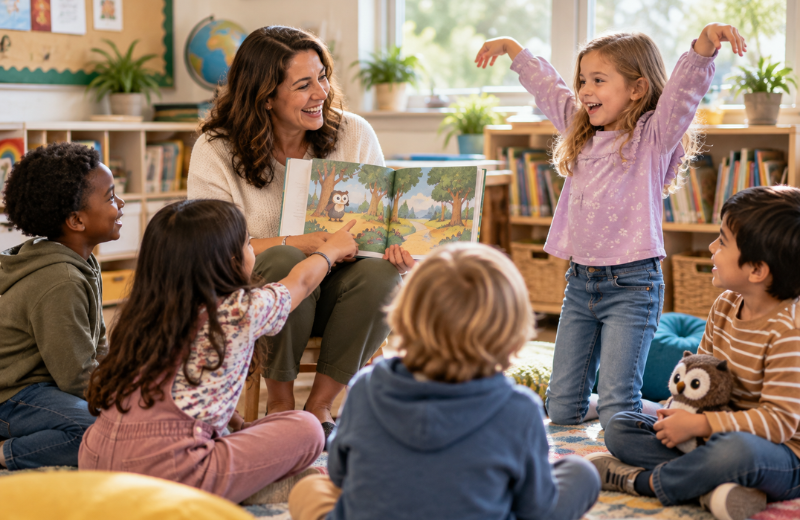
As a third-grade teacher, I love a good storytime. I also know that telling my students to sit quietly and listen doesn’t always go according to plan.
There is usually someone wiggling, someone desperate to tell you about their dog, a tooth popping out onto the carpet (true story!) and several who have somehow ended up facing the opposite direction.
When my own daughters were little, I learned the same lesson at home.
Sometimes our best reading happened with one child curled beside me and the other quietly playing with her toys. They taught me something I’ve carried into my work as an educator: engaged children don’t always look like still children.
Whether you’re reading in a classroom, library, museum, or community program, or at home, the goal isn’t perfect sitting. It’s connection, participation, and learning.
How Do You Keep Children Engaged During Storytime?
Keeping children engaged during storytime doesn’t require them to sit perfectly still. Giving children something to listen for, incorporating movement, asking accessible questions, using repetition, assigning simple jobs, connecting stories to real life, and following reading with a hands-on activity can turn storytime into an active learning experience.
Here are seven strategies that can help.
1. Give Them Something to Listen For
Before opening the book, give children a simple mission. In Lily’s Special Compass, Lily uses her senses as she searches for her missing compass. Before reading, ask children to gently touch their eyes, ears, nose, mouth, or hands each time Lily uses one of her senses.
Suddenly, children aren’t just listening. They’re listening for something. In my classroom, I found that a little challenge could transform attention. Tell children to look or listen for something in the story and suddenly you have a room full of detectives. Even with fifth graders, I found that a simple challenge could completely change how they listened to a story. During one lesson, I asked students to look for a tiny butterfly hidden on each page of the storybook. They loved following it from page to page, and suddenly, even my older students were studying every illustration, eager to spot where the butterfly had landed next.
2. Let Them Move
Movement doesn’t have to interrupt storytime. It can be part of it. While reading Cleo’s Cold Day, invite children to shiver when Cleo is cold, wrap their arms around themselves to get warm, or demonstrate a kind action. Use simple prompts such as:
- “Show me with your body.”
- “Can you move like the character?”
- “Freeze! What do you think will happen next?”
Even a brief movement break can give children a way to participate physically before bringing their attention back to the story.
3. Ask Questions Children Can Actually Answer
Discussion questions don’t have to sound academic to deepen learning.
Instead of asking, “Why did the character act that way?” Ask:
- “How do you think Lily feels?”
- “What did you notice?”
- “What would you do?”
- “Show me Cleo’s face right now.”
In Lily’s Cloudy Feelings, children can identify Lily’s emotion, make the expression themselves, and notice what happens as her feelings change.
The best question isn’t always the most complicated one. It’s the one that makes children want to participate.
4. Use Predictable Participation
Children love knowing what’s coming. Choose a repeated word, sound, gesture, or phrase they can do throughout the story. If there’s wind, everyone says, “Whoooo!” If a character takes a slow breath, everyone breathes along. My own children always loved books with repeated phrases and eventually I wasn’t allowed to say those parts. I was merely there to turn the pages. Repetition gives children ownership of the story, and that’s powerful.
5. Turn Children Into Helpers
Give energetic children a job. Ask someone to hold a prop, point to something in an illustration, demonstrate a movement, or help you remember what a character did. With Tree’s Gratitude Garden, children could become “gratitude detectives,” looking for the little treasures Lily, Oliver, and Cleo discover. A child who struggles to sit and listen may thrive when asked to do something with the story.
6. Connect the Story to Real Life
Stories become more meaningful when children recognize themselves in them.
In Cleo’s Cold Day, Cleo’s friends notice she’s uncomfortable and help her. Afterward, ask: “What could you do if you noticed someone needed help?”
You can act out simple situations. For example, dropping crayons, sitting alone, needing help carrying something. Then let children demonstrate kindness.
Stories provide a safe place to practice situations children encounter in real life.
7. End With One Thing Children Can Do
Don’t let the learning end when you close the book. After Lily’s Special Compass, take a five-senses walk. After Tree’s Gratitude Garden, find one “gratitude treasure.” After Cleo’s Cold Day, challenge children to do one small act of kindness. Keep it simple.
After many years as a teacher, and now as the mother of two college-age daughters, I’ve learned that children rarely remember every carefully chosen word we say. They remember how experiences made them feel. They remember being invited into the fun.
So the next time storytime gets wiggly, don’t fight the wiggles. Use them. Invite children to move, wonder, predict, notice, laugh, and participate. Because the most memorable storytime isn’t necessarily the quietest one.
It’s the one children can’t wait to join.
Looking for Stories You Can Put These Ideas Into Practice With?
Julie uses several Labyrinth Adventures stories throughout this article because the books were created to invite children into the experience, not simply ask them to sit and listen. The K–1 Storybook Curriculum Kit includes 16 illustrated stories plus ready-to-use resources and activities that help children explore focused attention, emotions, kindness, relationships, and self-regulation through story and participation.
See what’s included in the K–1 Storybook Curriculum Kit →

Julie Braumberger is Director of Education at Mind Body Align, a former third-grade teacher, and co-creator of Labyrinth Adventures. She draws on her classroom experience to develop practical whole child development resources that help children build self-regulation, emotional awareness, connection, and other skills they can use in school and beyond.