



Listen or Download Article Audio
Some of my favorite conversations with kids have started with a book. Then wandered as far from the story as Mo Willems’ Pigeon from what he was supposed to be doing.
A character does something that reminds them of school. A problem in the story reminds them of something a friend said. One innocent question somehow leads to a 25-minute conversation when everyone was supposed to be asleep 20 minutes ago.
If you have ever met a human child, you know they usually don’t need much encouragement to ask questions or tell a story. They just need an opening.
Reading together gives us one.
This kind of back-and-forth reading even has a name in early literacy: dialogic reading, an approach that uses questions, listening, and conversation to make children active participants in shared reading.
What should you talk about after reading with a child? Start with something that genuinely interests you in the story. Ask what your child thought a character was feeling, what they might have done differently, or whether something similar has ever happened to them. Then listen and let the conversation go wherever your child takes it.
And while I love the idea of cozy bedtime story moments, let’s be real: sometimes my kids are reading to me while I’m cleaning up the kitchen. Sometimes I’m reading while they’re picking up toys. Sometimes we’re trying to squeeze in a few pages on the way to school because somebody remembered they have an Accelerated Reader (AR) goal.
The conversation still counts.
Start with the story in front of you.
You don’t need prepared questions or a note card. Something that just happened in the book is enough.
8 Questions to Ask Kids After Reading
- What would you have done?
- Has anything like that ever happened to you?
- Why do you think they did that?
- How would you feel if this happened to you?
- What do you think happens next?
- Would you have made the same choice?
- Which character would you want to be friends with?
- Was there anything in this book that surprised you?
I especially like “Has anything like that ever happened to you?” because that’s the bridge from their story to your child’s story. That’s where connection, empathy, problem-solving, and emotional awareness can happen.
If coming up with questions on the spot isn’t your thing, some children’s books do the work for you! Our Labyrinth Adventures storybooks include discussion questions that help children connect a character’s experience to their own feelings, relationships, choices, and everyday challenges. You can use one question to get the conversation started and see where your child takes it.
Let Your Child Take The Conversation Somewhere Else
If my kids are anything like yours, the cozy conversations can last far past bedtime. I try to meet them in their rooms well before I actually expect them to close their eyes, just in case their mouths and their hearts are wide open for chatting.
If “Why do you think the character was upset?” somehow turns into a story about something that happened at recess three days ago, that’s not getting off topic. That’s probably the conversation worth having.
Storytime doesn’t have to happen at bedtime
Reading and conversation can happen while you’re:
- driving to or from school (with the child reading, obviously)
- making dinner, folding laundry, picking up toys
- waiting at an appointment
- eating an after-school snack
- sitting in the car waiting for practice to start
- hanging around the library after choosing books
And they don’t even have to happen at the same time every day. Your child reads to you in the car on the way to school in a last-ditch effort to hit an AR goal. Later that afternoon, instead of asking the dreaded “How was school?,” use these instead:
- “Hey, what ended up happening in that book?”
- “I was thinking about that character from this morning. Were you right about what was going to happen?”
- “Would you recommend that book to your friends?”
- “Who was your favorite character?”
- “Did anything weird happen after the part I heard?”
- “Okay, catch me up. What did I miss?”
Those sound like actual conversation, not a teacher asking for an oral book report.
Show them what active listening looks like
Put the phone away. Give them your attention. Look toward them when possible, and remember that connection doesn’t require sitting knee-to-knee maintaining perfect eye contact.
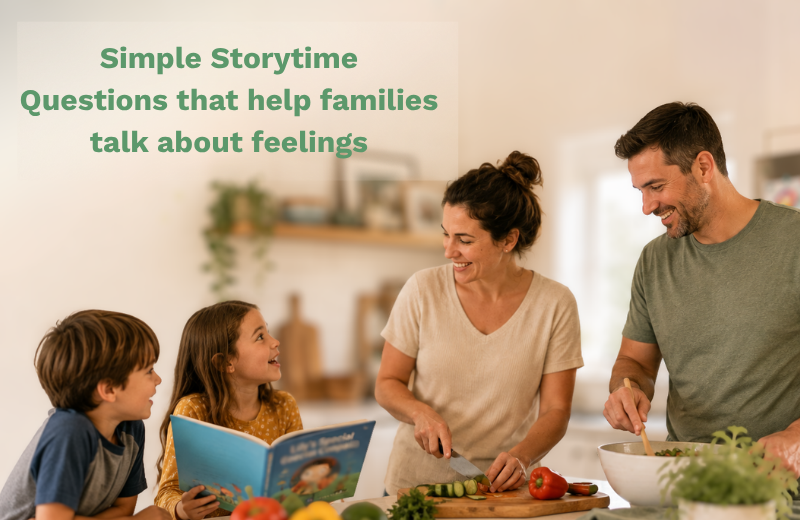
You might be brushing their hair. They might be sorting laundry while you’re putting it away. You might be unloading the dishwasher while they lean against the counter telling you about a fictional dragon who has somehow led them into a very real story about their best friend.
The busy day can still happen. So can the connection.
Active listening can simply mean not interrupting, asking a follow-up question, remembering something they said, or saying, “Wait, tell me more about that.”
Don’t rush to teach a lesson
When a child connects a story to a real problem, adults are very good at immediately providing The Lesson.
Sometimes ask one more question instead.
“What do you think you could do?”
“What do you wish had happened?”
“What do you think your friend was feeling?”
“What would you try next time?”
That lets children practice thinking through emotions, relationships, choices, and problems rather than having us hand them the answer. Stories give children a low-pressure place to think through real-life situations before they’re in the middle of one.
The Conversation IS the Point
You don’t need a perfect bedtime routine, a list of discussion prompts, or even a particularly deep book.
Read together when you can. Ask what they read at school when you can’t. Ask something you’re genuinely curious about. Listen to where your child takes the conversation.
Some nights you’ll get, “I don’t know.”
Some nights you’ll hear an extremely detailed explanation of a fictional character’s entire day.
And every once in a while, a story will open a door to something your child has been waiting to tell you.
Those are the conversations worth staying up a little late for.
For educators: Consider sharing this article and questions with families in a classroom newsletter, family resource page, or take-home reading activity. A few simple prompts can help extend conversations about stories beyond the classroom.

Brooke Unger Educator at Mind Body Align. She earned a degree in Educational Assisting and a Behavior Management certificate from North Central State College. Her experience as an elementary school teacher’s aide showed her how attentional training, relationship-building, self-regulation, and practical life skills can positively transform a classroom. Brooke now writes articles and teaches young children while supporting Mind Body Align’s mission to create successful learning environments. She lives in Bellville, Ohio with her husband and two daughters.
Looking for more ways to turn stories into meaningful conversations? Mind Body Align shares practical resources, story-based activities, and simple strategies that help children build self-awareness, connection, and skills they can use in everyday life. Join our community