


Listen or Download Article Audio
October is a month filled with spooky decorations, scary movies, and haunted houses. For many children, this can be a time of excitement, but for some, it can bring feelings of fear and anxiety.
Ghost stories told around the campfire and eerie decorations in the neighborhood, can trigger powerful emotions in children and adults.
What if we use these moments of fear as opportunities to practice calming techniques?
How Can Self-Regulation Help Children When They Feel Scared?
Self-regulation strategies can help children notice what is happening in their bodies and choose something that helps them respond to fear. Slow breathing, noticing the five senses, using calming imagery, and counting breaths are simple skills children can practice when they are calm so they are more familiar when scary or overwhelming feelings arise.
What Happens in the Body When We Feel Fear?
Imagine yourself walking through a haunted house. The lights are dim, strange noises are coming from every direction, and you feel your heart start to race. Your palms might get sweaty, your muscles tense, and you may even feel a little shaky. These are all normal responses to fear, a powerful emotion that prepares our body to respond to danger.
But what’s really happening in your body?
When we feel scared, our brain sends signals that release stress hormones like adrenaline and cortisol. These hormones prepare us to either fight, freeze, or flee from the perceived threat. This is a helpful response when we’re actually in danger, but in the context of a haunted house or a scary movie, it can leave us feeling overwhelmed and on edge.
Slow, intentional breathing can help the body shift toward a calmer state.
When we apply self-regulation techniques to our experience of fear, we can start to manage our emotional response.
4 Self-Regulation Strategies for Kids When They Feel Scared
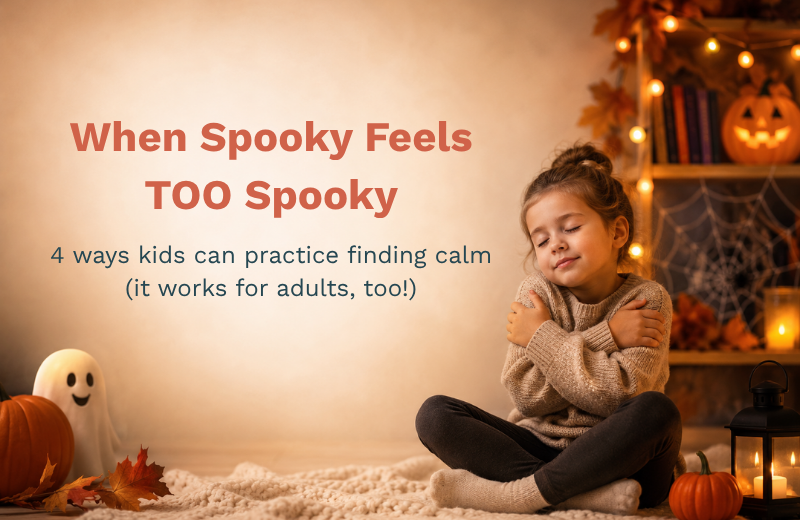
1. Hugging Breath: A Simple Technique for Finding Calm
One effective technique is Hugging Breath. This exercise is as comforting as it sounds and can be especially helpful for children when they’re feeling scared. Here’s how it works:
- Cross your arms over your chest as if you’re giving yourself a big hug.
- Take a deep breath in, feel your chest rise against your arms.
- Hold your breath for a moment.
- Slowly exhale, feel your body relax as you let go of the breath.
This simple practice can help soothe the nervous system, making it easier to calm down when fear starts to take over. It’s a great tool to use anytime, whether you’re watching a scary movie, walking through a spooky part of town, or just feeling anxious.
Practice Hugging Breath together when children are already calm so the steps feel familiar when bigger emotions arise.
Download Your Free Hugging Breath Exercise
2. Noticing with Your Five Senses
Another technique involves engaging the five senses. When fear strikes, our minds often become overwhelmed with thoughts of what might happen next. Bringing our awareness into the present moment by tuning into our senses can help to break this cycle.
Here’s a way to practice:
- Notice five things you can see: Take a moment to look around and really notice your surroundings. What colors, shapes, and textures stand out to you?
- Notice four things you can touch: Focus on the sensation of your clothes against your skin, the feel of your feet on the ground, or the texture of an object nearby.
- Notice three things you can hear: Tune into the sounds around you. It could be the hum of a refrigerator, the rustle of leaves, or the distant sound of traffic.
- Notice two things you can smell: Breathe in and notice any scents in the air. Is it the smell of food, fresh air, or something else?
- Notice one thing you can taste: If you have something to eat or drink nearby, take a moment to savor the taste. You may even notice the absence of taste.
By bringing attention to our senses, we can shift attention away from scary thoughts and toward what is happening around us in the present moment.
3. The Power of Imagination: From Haunted Houses to Peaceful Places
Our imagination is powerful, and it can either fuel our fears or help us find peace. Let’s try a little exercise:
First, close your eyes and imagine yourself in the middle of a haunted house. It’s dark, there are strange noises, and your heart starts to beat faster. Notice the reactions of your body. Perhaps you feel tense, your breathing becomes shallow, or your palms get sweaty.
Now, take a deep breath and imagine yourself in a peaceful, stress-free environment. Maybe it’s a sunny beach, a quiet forest, or your favorite cozy spot at home. Do you notice your body starting to relax? Possibly your heart rate slows, your muscles loosen, and you feel a sense of warmth and safety.
This exercise highlights how quickly our bodies can respond to what we imagine. Shifting what you imagine can influence how you feel emotionally and physically.
4. Counting Your Breaths: How Many to Calm Down?
Another simple but effective practice is counting your breaths. This can be especially helpful when you’re feeling scared or anxious.
Start by sitting comfortably and taking a deep breath in.
- Count “one” as you inhale.
- Then “two” as you exhale.
- Continue counting each breath until you reach ten.
- Then start over.
Pay attention to how your body feels with each breath.
How many breaths does it take before you notice your heart rate slowing down and your body feeling more relaxed?
Breath counting is a great tool to use in any situation where you feel overwhelmed. It’s easy to do, requires no special equipment, and can be done anywhere.
Why Practice Self-Regulation Before Kids Feel Overwhelmed?
Teaching children techniques like Hugging Breath, noticing with the five senses, and imagining peaceful places gives them simple tools they can practice for navigating fear and other overwhelming emotions.
The goal isn’t to prevent children from feeling afraid. It’s to help them recognize what they’re feeling and become familiar with strategies they can try when they need them.
These tools become more useful with practice, which is why teaching emotional skills before children need them can be so important.
So the next time something goes bump in the night, remember, you have the power to breathe through it.

Mind Body Align develops science-informed, story-based whole child development resources for elementary-age children. Drawing on experience in education and child development, our team translates research on self-regulation, emotional awareness, focused attention, empathy, and relationships into practical strategies children can understand and practice in everyday settings.