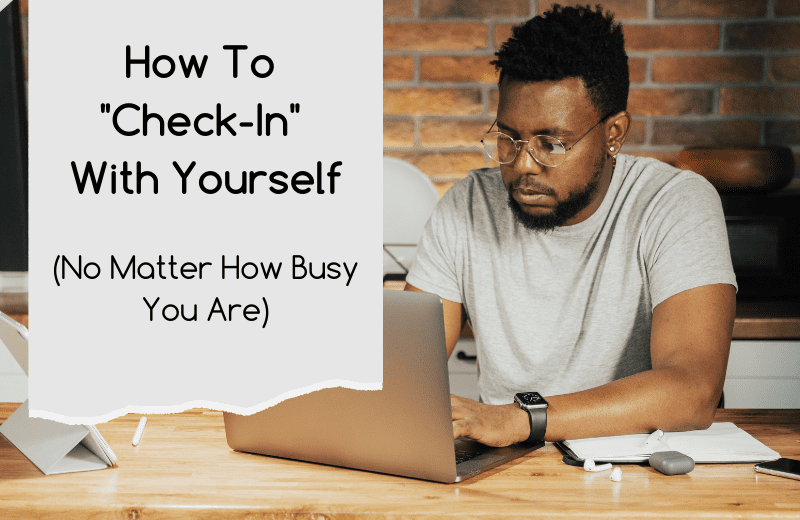



It’s 2:00 in the afternoon. You haven’t had lunch yet, and you still have a mountain of things to check off your list before you can leave for the day. Now is the perfect time to pause and check in with yourself.
The reality is this: when we feel the most “on edge,” that IS the most important time to pause, take a deep breath, and allow ourselves to have a “moment” before we start again. All you need is a few minutes. Here are three ways you can use just five little minutes to check in with yourself.
5-Minute Seated Check-In
Set a timer for 5 minutes. Sit up tall in your chair. Place your hands on your desk or on your lap. If it feels good, close your eyes. Take three deep breaths, each time trying to hold a little longer and to exhale a little slower.
Picture yourself at the end of the workday. You have completed everything you needed to and you feel great. You feel proud of yourself. Check-in with our body now and feel any places where tension is living. Make an active effort to relax the muscles there. Unclench your jaw. Tell yourself that you work hard and you deserve these few moments to check-in with yourself.
Now, repeat the three deep and intentional breaths you used to start this short practice. Once you are ready, open your eyes, turn back on your computer screen, and proceed with a renewed sense of purpose and calm.
5-Minute Movement Check-In
Before you begin this practice, find an audio sound that makes you feel comfortable and calm. I suggest checking out our playlist on Spotify titled, Reboot and Recharge, where every track is under five minutes.
Grab your headphones and find a spot that is not at your desk where you can stand or sit comfortably. Once you’ve found a comfortable position, close your eyes and begin the deep breathing practice mentioned above. Start to lean your head to one side, gently encouraging yourself to go as deep as feels comfortable for you. Repeat on the other side.
Next, rotate your shoulder backward and forwards in slow and deliberate motions. Feel where any tension exists in your neck and back. Take deep breaths in and out. Rotate your wrists back and forth. Pull gently on your fingers and massage your thumb.
Listen to the music as you breathe deeply. Once you are ready, open your eyes, and proceed with a renewed sense of purpose and calm.
Under 5-Minute Check-In
Grab a piece of paper and your favorite pen. Write down three of the most important things you want to get done before you leave work (or your desk). Now, write down the worst-case scenario if you do not finish your work today. Next, cross off this worst-case scenario with your pen. It is highly unlikely that your worst-case scenarios will come to fruition.
We tell ourselves that the world will stop moving if we don’t perform to our unreal expectations. Head back over to your top three priorities. Out of the three you wrote down, circle the one that is most critical to you. Take three deep and intentional breaths and allow yourself to work on that one task until it is complete. Once it is done, you should cross off the circled task.
By using visual indicators to show what we can and can not accomplish in a day, we give ourselves permission to acknowledge what is possible.
Checking in with ourselves doesn’t have to be complicated.
You can use one of the techniques mentioned here or you can simply take a deep breath and ask yourself if you are ok at this very moment. You can ask yourself what it is you need. Self-care isn’t always packaged the way it is in magazines and on Pinterest. Sometimes, we have to fit it in whenever and wherever we can, like in the middle of a busy workday, in between classes, or on the drive home. The point is that self-care IS for you. You deserve a moment to check in with yourself. You are the only one who truly can. Give yourself a minute, or five even, to take a deep breath and know that you are ok.
Mind Body Align creates science-informed, story-based whole child development resources for elementary educators and youth programs. Through Labyrinth Adventures, children practice self-regulation, focused attention, emotional awareness, communication, and connection through stories and everyday learning experiences.