



Download or Listen to Article Audio
“Calm down.” (And let’s face it, sometimes the “Calm down” has an exclamation point at the end!)
I said it as a teacher. I said it as a mom. And I’m fairly certain it has never actually made my upset child calm down.
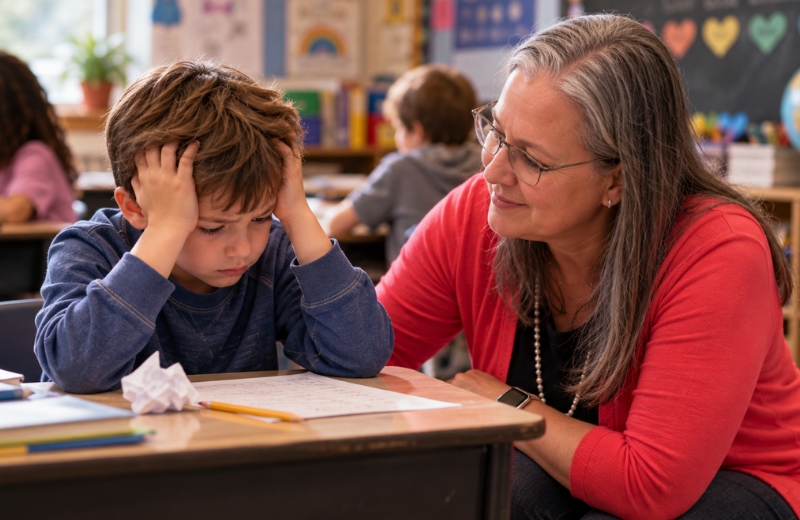
As a third grade teacher, there were plenty of moments when emotions had to be regulated before learning could continue. Indoor recess was announced when he had already planned his outside games. Someone didn’t get to be first in line. A spelling test paper ripped while erasing. Or the classroom game ended right before their turn.
To an adult, some of these problems may seem small. To an eight-year-old, they can feel enormous. I saw the same thing while raising my two daughters. Sometimes what I thought was a problem that needed solving was actually an emotion that needed somewhere to land first. Now they’re in college, but I still have to remind myself to listen before fixing.
There’s science behind that idea. Children learn how to handle big emotions over time, and the adults around them play an important role. When we stay close, listen, and practice calming strategies with them, children begin to learn how to do those things for themselves.
This is called co-regulation.
In other words, before we ask children to calm themselves, sometimes we need to help them get there.
What Can You Say Instead of “Calm Down”?
Instead of telling an upset child to “calm down,” acknowledge what they’re feeling and let them know you’re there to help. Simple phrases like “I’m here with you,” “This is really hard right now,” or “Let’s take one slow breath together” can give a child support before you move into problem-solving.
Acknowledge the Emotion Before Solving the Problem
When a child is frustrated, say: “This is really hard right now. I’m here.” Then pause. We don’t always need to follow the sentence with a solution. Naming what we’re seeing and staying close communicates to the child that they don’t have to figure this out alone.
My daughter would get so mad at herself when she was struggling to learn to read, she would even hit her head with her hand. My teacher instinct was to jump in and show her what to do, but what she often needed first was for me to recognize how frustrated she was. Instead, I could say, “I know this is hard, and I can see how hard you’re trying. Let’s take a breath, and then we’ll try that word again together.”
Notice the order. Acknowledge the emotion first, problem-solve second.
When children are disappointed, say:
- “You really wanted that to happen.”
- “It’s okay to be disappointed. I’m going to stay with you while you’re feeling this.”
We don’t have to convince children that everything is fine. We can acknowledge that, at that moment, it isn’t fine for them.
When Emotions Are Really Big, Use Fewer Words
When a child is overwhelmed, fewer words may be better. Say:
- “I’m right here.”
- “You’re safe. Let’s breathe together.”
- “Would you like to sit with me or have a little space?”
- “Let’s get your body comfortable first. Then we’ll talk.”
Children’s ability to manage emotions develops over time, and relationships with responsive adults are an important part of that development. Research on co-regulation suggests that supportive interactions between adults and children can help children develop their own self-regulation skills.
Through repeated practice, children can learn to notice big emotions and body clues before they desperately need a strategy. This is something we reinforce through our Labyrinth Adventures curriculum, too. Children don’t simply hear, “Don’t be mad” or “Stop worrying.” They learn to notice emotions and body clues and practice strategies. For example, breathing, pausing, moving, or asking for help. And they notice the big emotions and the body clues before they desperately need the strategy to calm them.
We Can Be the Calm
One of my daughters used to come into my classroom after school in tears over friendship problems. I was her mom, but I was also a teacher, so you can imagine how quickly my problem-solving brain kicked in. Did you tell her how you felt? What happened before that? What could you do tomorrow to make it better? Over time, I learned that those questions could wait. What she often needed first was simply: “That really hurt your feelings. Tell me what happened.” She needed me to acknowledge how she was feeling before providing solutions.
Years later, with two college-aged daughters, I’m still practicing that lesson. The problems change. The emotions don’t disappear. And neither does the need to know that someone is listening.
Four Phrases to Use When a Child Has Big Emotions
The next time a child is having a big emotional moment, you don’t need the perfect words. Start with something simple:
- “I see you’re having a hard time.”
- “I’m here with you.”
- “Let’s take one slow breath together.”
- “When you’re ready, we’ll figure out what to do next.”
Co-regulation is the support adults provide as children learn to understand and manage their emotions and behavior. It can include staying close, listening, modeling strategies, helping children name what they’re experiencing, and practicing ways to respond.
Co-regulation isn’t about removing every difficult feeling or making children dependent on adults. It’s part of how children learn regulation, with adults modeling, coaching, and practicing these skills alongside them. Research also cautions against treating regulation simply as a way to make children quiet or compliant. The goal is to support their well-being and grow their capacity to manage big emotions.
So next time “Calm down!” is on the tip of your tongue, do something different.
Get close. Lower your voice. Listen.
And let your calm say, “You don’t have to handle this big feeling by yourself. I’m here, and we’ll work through it together.”

Julie Braumberger is Director of Education at Mind Body Align, a former third-grade teacher, and co-creator of Labyrinth Adventures. She draws on her classroom experience to develop practical whole child development resources that help children build self-regulation, emotional awareness, connection, and other skills they can use in school and beyond.